AI-Powered Experiential Fragrance Search
An AI-powered fragrance discovery experience for a top US retailer, designed around how people actually think about scent.
00

problem
Fragrance remains one of the hardest categories for online retail to translate well. The tools available — keyword search, fragrance family filters, note lists — were designed around inventory management, not around how people naturally think about scent. Shoppers describe fragrance in terms of moods, memories, and associations. They don't naturally navigate by category. The gap between how people experience fragrance and how platforms catalog it is where discovery breaks down. This project started from that gap.
solution
The solution centers on two connected ideas. First, a search experience where shoppers describe what they are looking for in their own words — a mood, a memory, a place — and the platform translates that into a small set of strong matches. Second, an experiential visualization that represents a fragrance’s character as it evolves over time. Together, they shift the role of the platform from a catalog to a discovery tool. The designs shown throughout are wireframes representing an early-stage exploration, currently in active development.
A search that speaks the user's language, not the industry's
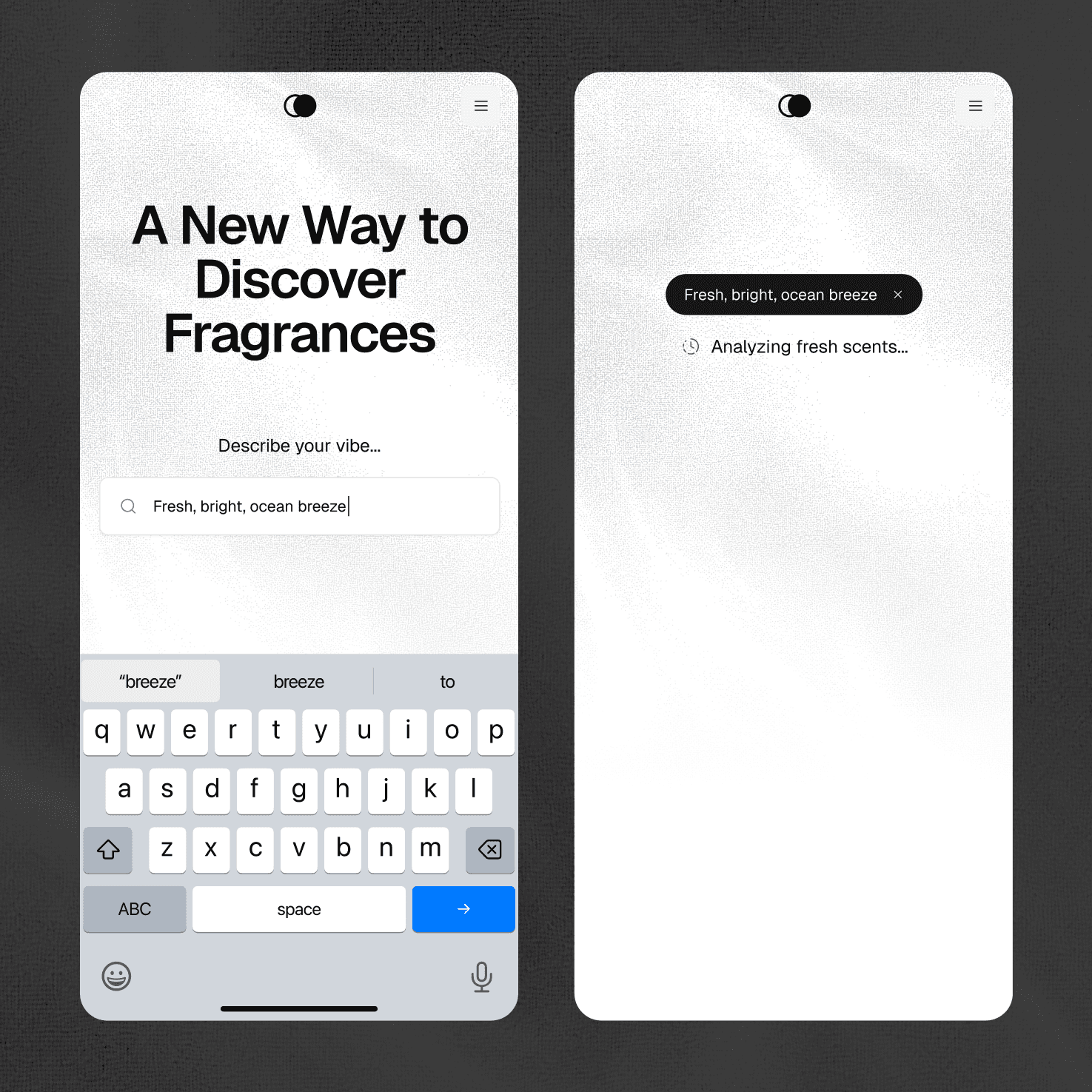
The entry point is a single search bar and an open invitation: describe your vibe. Shoppers type how a fragrance should feel, where they want to be, or what they want to evoke — not which notes they're looking for. Once submitted, the query becomes a persistent pill and the platform begins analyzing. The transition from input to analysis is intentional — the brief processing moment signals that something meaningful is happening, not just a filter being applied. As the platform works through the query, the feedback updates in step with each element being interpreted — confirming that "fresh," "bright," and "ocean breeze" are each being read in turn rather than flattened into a single keyword search.
Returning a short list the platform is confident in
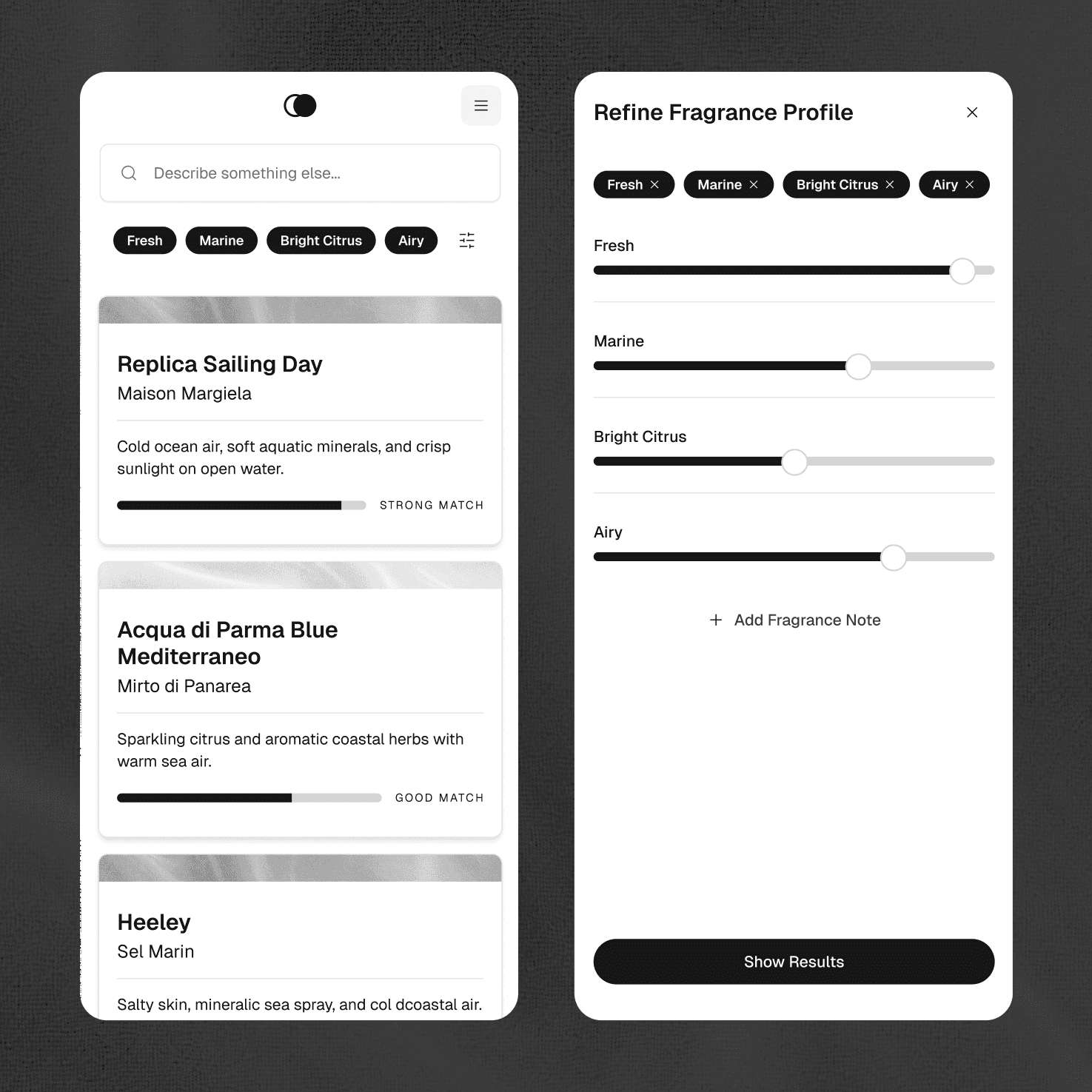
Results surface with explicit confidence scores so the ranking is transparent and the shortlist earns trust rather than demanding it. For users who want more control, a refinement panel exposes the underlying note profile as adjustable sliders — letting them increase or reduce the weight of individual notes and re-run results. The goal throughout is a small, confident set of recommendations rather than an exhaustive list that puts the burden of evaluation back on the user. The refinement panel exposes the interpreted fragrance profile as editable qualities rather than traditional filters. Users can remove notes that feel off, add qualities that feel missing, or adjust the weight of each note before re-running results.
Designing for the search that doesn't land cleanly
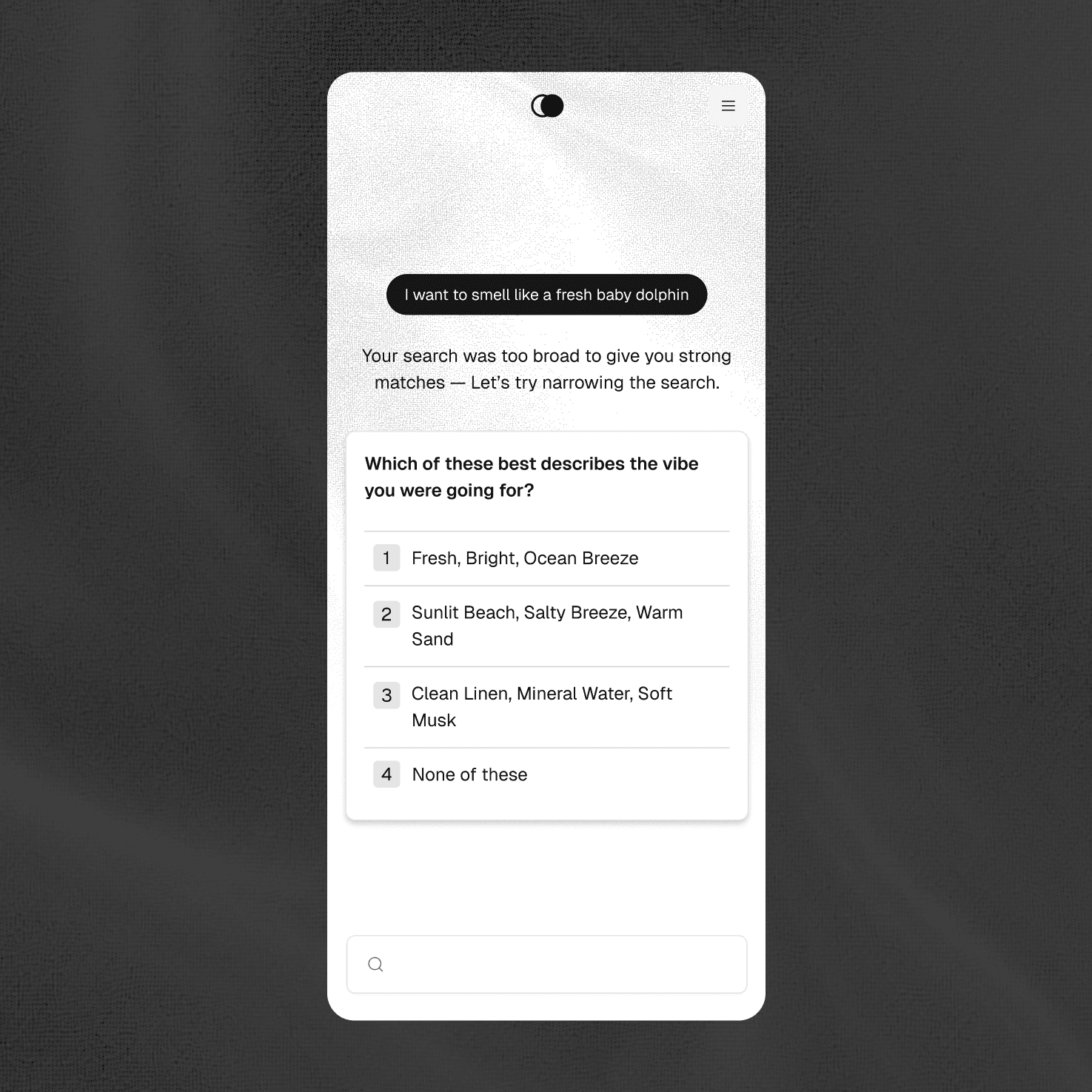
Not every query maps cleanly to a scent profile, and designing around that from the start felt more true to the product than treating it as an edge case. When a search pulls too wide a range to return a confident set, the platform offers evocative interpretations — described in the same natural language the user already speaks — rather than returning weak results or nothing at all. Selecting an option narrows the search. Selecting "None of these" returns the user to an editable prompt. The loop always terminates somewhere useful.
Giving fragrance a visual language
The most differentiated element of the experience is a real-time volumetric animation that represents a fragrance's character as it moves through its phases. Color, density, movement speed, and form all shift as the scent evolves: a bright burst at top notes, a flowing aquamarine through the heart, a slow amber settling at base. The visualization system is being designed to map fragrance data to changes in color, density, movement, and form. Not a decorative loop, but a visualization grounded in the fragrance's real composition. This work is currently in active development.
Connecting the visual to the story beneath it
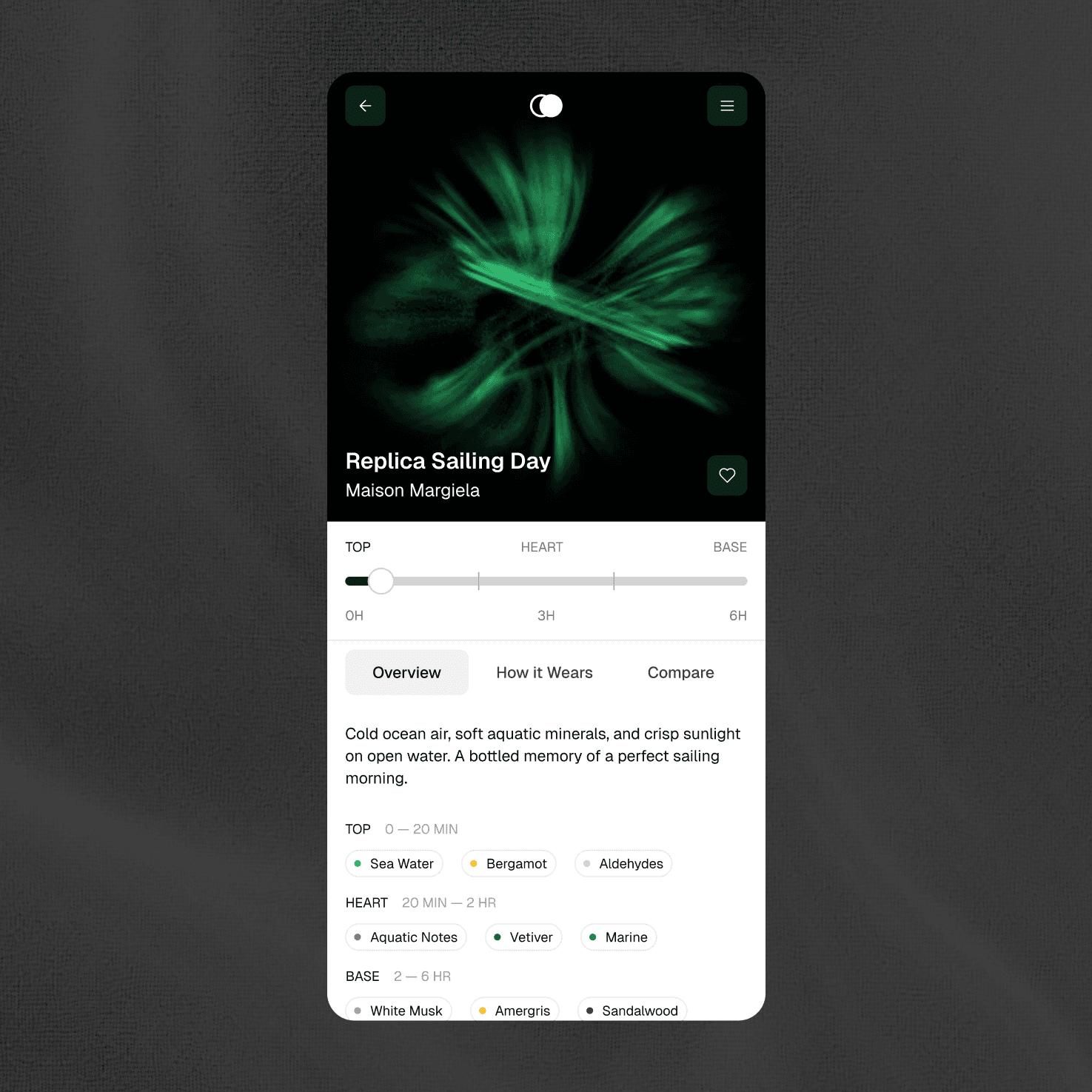
The detail view brings search and experience together. The animation occupies the top third of the screen and a scrubber below it advances automatically on page load — moving in sync so users understand the interaction before they ever touch it. Note breakdowns, accord profiles, and performance data sit below, organized across Overview, How It Wears, and Compare tabs. The color mapping between the animation and the note pills is intentional: the dot next to "Marine" matches the aquamarine in the animation above it. That visual correspondence is where the concept becomes legible without instruction. The detail view is currently in wireframe.
Where it stands
This is an active project. The core search flows — happy path and refinement — are defined, and the primary interaction model for the detail view is in early testing and iteration.
Additional visualization modes are in development, including How It Wears — a timeline of note prominence across the fragrance's arc driven by the scrubber — and Compare, for evaluating matches side by side. Accessible versions of both are planned in parallel, encoding meaning through structure and motion rather than color alone, so the experience works equally well for colorblind and visually impaired users.
The longer horizon is about deepening the connection between a fragrance's actual composition and its visual representation — working toward AI-generated experiential forms genuinely derived from scent data rather than approximated from it. That foundation also opens a creative direction layer for brands, giving fragrance houses a new medium to express their identity through the visual character of their own fragrances.
see also